Choose a New Standard:Player-CentricProficiency Development
Choose a New Standard:
Player-Centric
Proficiency Development
At Capital-SP Academy, every player receives a clear, honest, and measurable picture of where they stand — and where they can go. Our proficiency system replaces guesswork with data, giving players, parents, and coaches a shared language for development. The result is a personalised development tool that shows not just a number, but a roadmap.
"The focus for the young player should be on mastering the core skills and deploying these in co-operation with their peers and teammates… This plan would benefit from a jointly agreed strategy between the coaching staff and the player. The player input is an absolute must, as this engagement will increase intrinsic motivation and continued ownership and responsibility of their own development."
- We assess every player across four core attributes — PAC, DRI, PAS, and PHY — using standardised proficiency tests that produce objective, measurable results.
- Players and coaches collaborate to set targets and review progress using the Player Proficiency Card (PPC), fostering true ownership and motivation.
- Our coaching philosophy is vision- and values-driven, prioritising the long-term growth of each athlete over short-term results.
Questions Every Soccer Parent Should Be Asking
 True player improvement goes beyond the scoreboard. Capital-SP Academy tracks individual development through the Player Proficiency Card (PPC) — a personalised results card showing your child's scores across four core attributes: PAC (Pace), DRI (Dribbling), PAS (Passing), and PHY (Physical). Each attribute is scored 0–100, and an Overall Rating (OVR) combines them into a single at-a-glance indicator.
Regular testing sessions mean you can track changes in each attribute over time. A rising OVR — or improvement in a specific attribute your child has been working on — is concrete evidence of real development, independent of whether the team won or lost.
True player improvement goes beyond the scoreboard. Capital-SP Academy tracks individual development through the Player Proficiency Card (PPC) — a personalised results card showing your child's scores across four core attributes: PAC (Pace), DRI (Dribbling), PAS (Passing), and PHY (Physical). Each attribute is scored 0–100, and an Overall Rating (OVR) combines them into a single at-a-glance indicator.
Regular testing sessions mean you can track changes in each attribute over time. A rising OVR — or improvement in a specific attribute your child has been working on — is concrete evidence of real development, independent of whether the team won or lost.
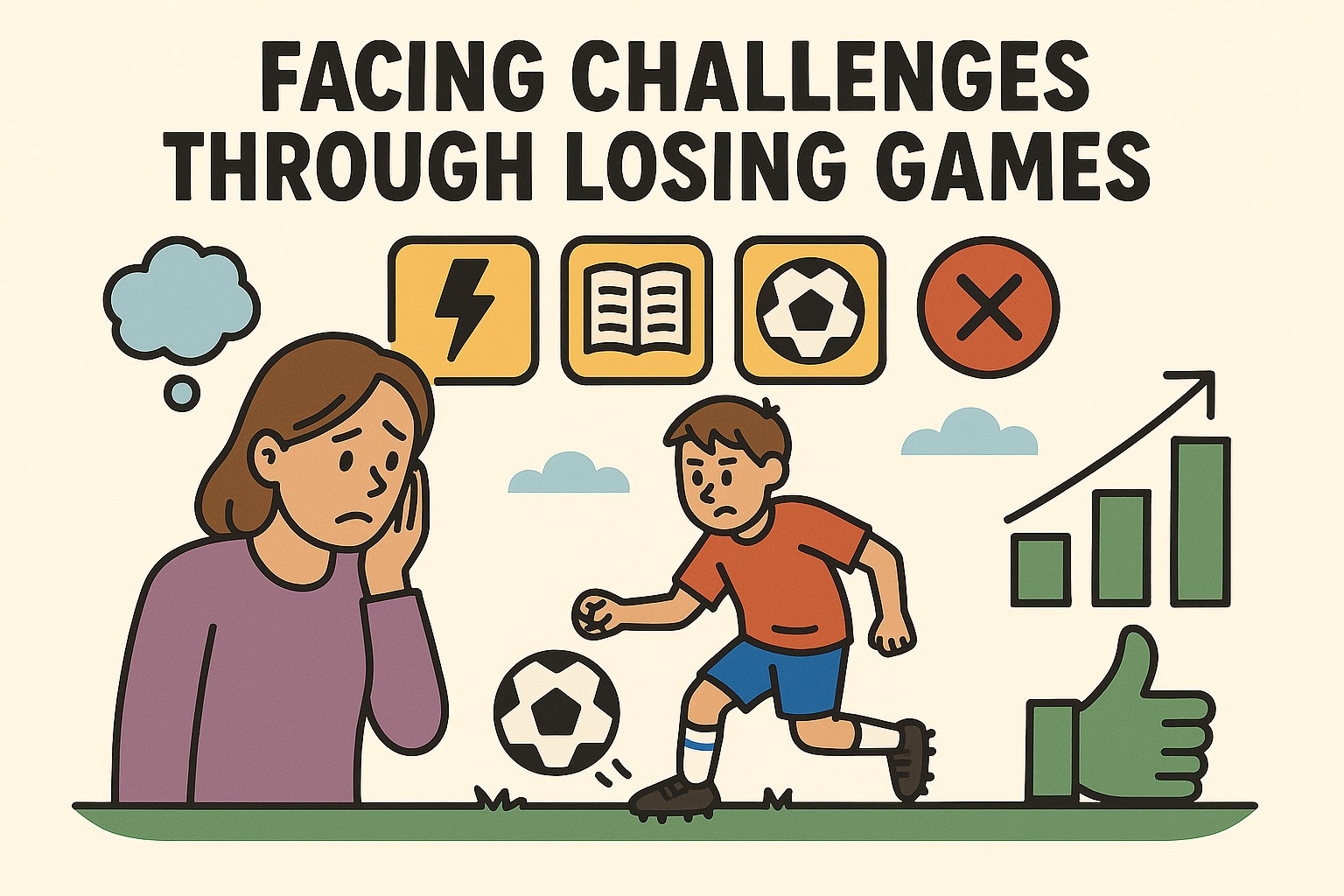 A winning record does not necessarily mean that players are developing the skills they need for long-term success. Many youth programs prioritise winning by focusing on the most physically advanced players or by stacking teams for easier victories. This can lead to short-term success but often leaves players without the technical foundation or game understanding needed as they progress.
Capital-SP Academy's proficiency system measures individual capability — not team results. A player's PAC, DRI, PAS, and PHY scores reflect what they personally achieved in standardised assessments, independent of who else was on the field. That's the difference between measuring development and measuring outcomes.
A winning record does not necessarily mean that players are developing the skills they need for long-term success. Many youth programs prioritise winning by focusing on the most physically advanced players or by stacking teams for easier victories. This can lead to short-term success but often leaves players without the technical foundation or game understanding needed as they progress.
Capital-SP Academy's proficiency system measures individual capability — not team results. A player's PAC, DRI, PAS, and PHY scores reflect what they personally achieved in standardised assessments, independent of who else was on the field. That's the difference between measuring development and measuring outcomes. Youth soccer can be a significant investment. It's important to know exactly what you're getting for your money. Capital-SP Academy provides transparent, measurable tracking of your child's growth through the Player Proficiency Card — a personalised results card generated after every testing cycle.
You receive specific scores for each assessed area, an Overall Rating, and proficiency icons that recognise areas of demonstrated strength. Progress is tracked over time, so you can see exactly how your child's scores change between sessions. That's not a promise — it's a record.
Youth soccer can be a significant investment. It's important to know exactly what you're getting for your money. Capital-SP Academy provides transparent, measurable tracking of your child's growth through the Player Proficiency Card — a personalised results card generated after every testing cycle.
You receive specific scores for each assessed area, an Overall Rating, and proficiency icons that recognise areas of demonstrated strength. Progress is tracked over time, so you can see exactly how your child's scores change between sessions. That's not a promise — it's a record.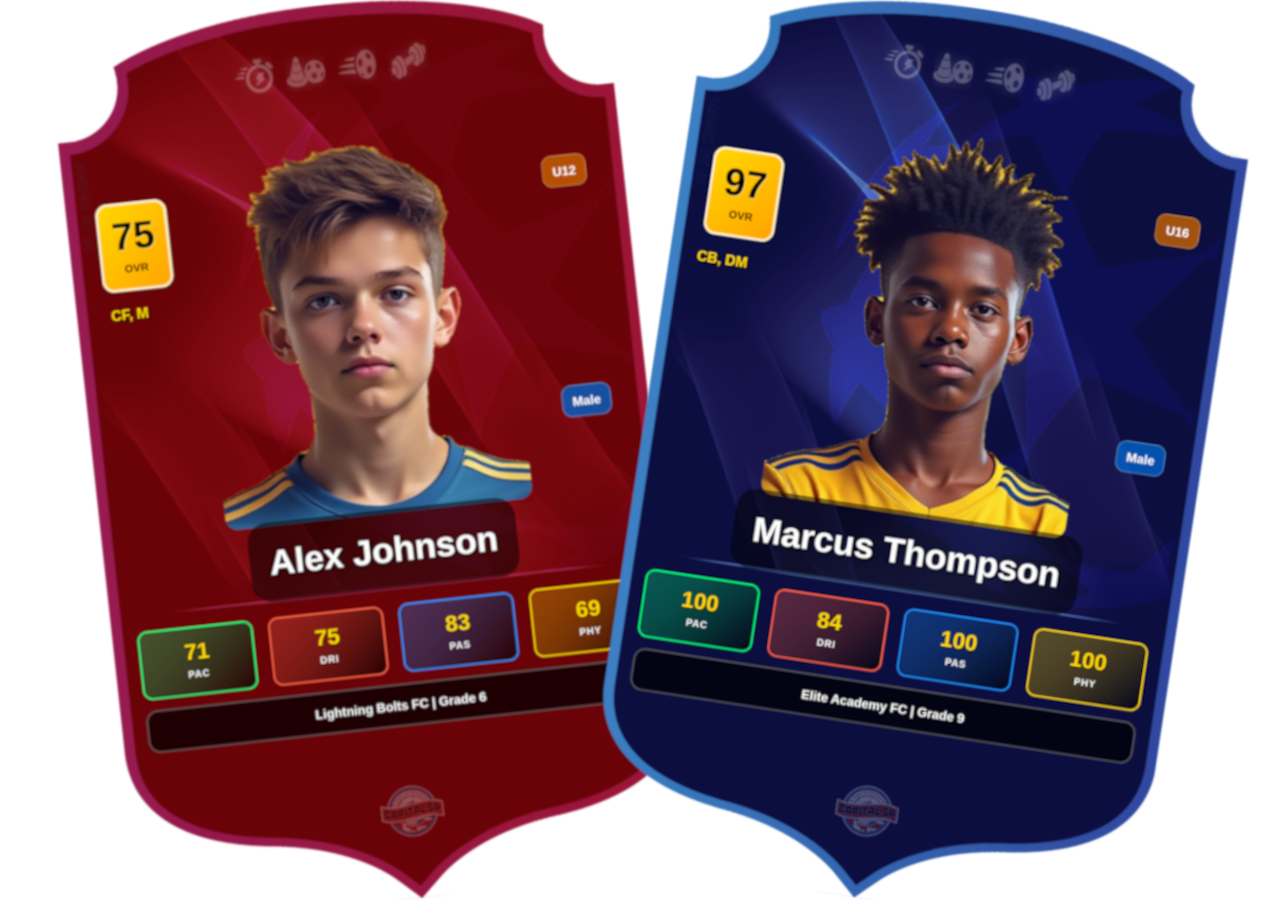 Capital-SP Academy is committed to real accountability through the Player Proficiency Card system. Every participant who undertakes proficiency testing receives a personalised PPC with four scored attributes and an Overall Rating, generated from standardised assessments that produce objective, reproducible results.
Results are promulgated online after each testing session. Coaches use the PPC to set development targets and review progress with players and parents. For advanced participants, the Journeyman programme adds a 52-attribute report covering Tactical, Technical, Physical, and Psychosocial qualities — assessed through structured observation over time.
This level of transparency and specificity is rare in youth soccer. It's what sets our programme apart.
Capital-SP Academy is committed to real accountability through the Player Proficiency Card system. Every participant who undertakes proficiency testing receives a personalised PPC with four scored attributes and an Overall Rating, generated from standardised assessments that produce objective, reproducible results.
Results are promulgated online after each testing session. Coaches use the PPC to set development targets and review progress with players and parents. For advanced participants, the Journeyman programme adds a 52-attribute report covering Tactical, Technical, Physical, and Psychosocial qualities — assessed through structured observation over time.
This level of transparency and specificity is rare in youth soccer. It's what sets our programme apart.
Why Accountability Matters in Youth Soccer
Parents invest time, money, and trust in youth soccer. Here’s why real accountability in player development matters.
Traditional Club Model
-
![Trophy Icon]() Focus on team wins
Focus on team wins
-
![Question Mark Icon]() Vague development promises
Vague development promises
-
![No Feedback Icon]() Little individual feedback
Little individual feedback



Accountable Player Development
-
![Progress Chart Icon]() Measurable individual progress
Measurable individual progress
-
![Assessment Icon]() Regular skill assessments
Regular skill assessments
-
![Communication Icon]() Transparent communication with families
Transparent communication with families



“Over 70% of parents say they want clearer feedback on their child’s soccer progress. Capital-SP Academy is built on that demand.”
Demand more. Choose real accountability for your child's soccer journey.
Discover Our AcademyWhat Real Accountability Looks Like
Every Capital-SP Academy participant receives a Player Proficiency Card — a personalised results card with four scored attributes (PAC, DRI, PAS, PHY) and an Overall Rating, generated from standardised assessments that produce objective, reproducible results.
No vague feedback. Just clear, specific data about your child's development — and a record of how it changes over time.
That's the difference between a programme that talks about accountability and one that delivers it.
![csp coach]() WHAT THE PROFICIENCY ASSESSMENTS MEASURE
WHAT THE PROFICIENCY ASSESSMENTS MEASURE
 WHAT THE PROFICIENCY ASSESSMENTS MEASURE
Capital-SP Academy's proficiency assessments are designed to measure the core physical and technical capabilities that underpin soccer performance. The specific methods used are proprietary to Capital-SP Academy and are reviewed and refined as our assessment methodology evolves — like any robust examination framework, the testing suite is regularly adapted to reflect advances in sports science and best practice.
What remains constant is what we measure: four key domains that map directly to the four attributes on your Player Proficiency Card.
DOMAIN 1 — PACE (PAC)
What is assessed: Speed, acceleration, change of direction, and dynamic movement — how quickly a player can cover ground, react to situations, and move effectively in match-relevant patterns.
What it tells you on the pitch: Can they get to a through ball before the defender? Can they recover when caught out of position? Can they press effectively, closing down space and time on the ball? Can they exploit transitions, turning defence into attack quickly? Pace is the foundation of physical competitiveness — it creates options that slower players simply don't have.
DOMAIN 2 — DRIBBLING (DRI)
What is assessed: Ball control while moving, the ability to maintain possession under pressure, and comfort handling the ball in tight or dynamic situations.
What it tells you on the pitch: A player with strong DRI scores can receive the ball and advance with it, beat opponents in one-on-one situations, and keep possession in congested areas of the pitch. These are the players who can turn a tight situation into an attacking opportunity — who give their team a creative outlet when space is limited.
DOMAIN 3 — PASSING (PAS)
What is assessed: Passing accuracy delivered consistently, and the ability to receive and control the ball effectively — the fundamental connection point of team play.
What it tells you on the pitch: A player with strong PAS scores can find teammates with short and medium-range passes, receive the ball cleanly, and execute the basic building blocks of possession football. Passing proficiency is the difference between a team that retains the ball and builds attacks, and one that gives possession away repeatedly.
DOMAIN 4 — PHYSICAL (PHY)
What is assessed: Overall physical profile — endurance, stamina, coordination, balance, agility, basic motor skills, and the ability to sustain effort over the duration of a match.
What it tells you on the pitch: A player who scores well here can compete for a full match without significant performance drop-off. They maintain their technical quality when fatigued — which is when most errors in youth soccer occur. Physical capability is the base that everything else rests on.
WHAT THE TESTS DETERMINE
The testing framework is built around four key principles:
- OBJECTIVITY — Each test produces a measurable, repeatable result. A participant's score reflects what they personally achieved, independent of who else was being tested or any third-party influence.
- FAIRNESS — Every participant completes the same assessments under the same conditions, meaning scores are genuinely comparable within age groups and across sessions.
- RELEVANCE — Every test directly relates to an on-field capability. Nothing is tested for the sake of testing — each assessment maps to real soccer situations and skills.
- REPRODUCIBILITY — If a participant retakes a test and performs at the same level, they should receive a consistent result. This gives confidence that improvements in scores reflect genuine development, not variability in the testing process.
YOUR PLAYER PROFICIENCY CARD (PPC)
After testing, every participant receives a personalised Player Proficiency Card displaying:
- Four core attribute scores (PAC, DRI, PAS, PHY) — each rated 0 to 100
- An Overall Rating (OVR) — a weighted combination of all four attributes
- Proficiency icons — displayed for any attribute where the player meets the academy's proficiency benchmark
- Player photo, name, age group, position, and team information
THE OVR RANGES:
75–100 → Exceptional proficiency
55–74 → Solid developing proficiency
35–54 → Emerging proficiency
Below 35 → Early stage — significant growth potential
IMPORTANT: These ranges are general guides. A 12-year-old with an OVR of 50 is at a very different stage than a 16-year-old with the same score. Always consider age and development context when interpreting any score.
WHY ATTENDANCE MATTERS
Test results have a validity period — they reflect a player's ability at the time of testing and are not indefinite. If a participant misses testing sessions, their PPC will be based on incomplete or outdated data, which directly affects the accuracy of their scores and overall rating.
Missing tests means:
- Some or all attribute scores may not reflect a player's current ability
- A PPC based on partial data can significantly understate a player's true level
- Proficiency icons can only be awarded based on completed assessments
- Progress tracking becomes less meaningful when there are gaps in the data
Think of it like any exam: if a student doesn't sit the test, they can't receive a grade. To get the most accurate and beneficial picture of a player's development, consistent participation is essential.
We strongly encourage all participants to attend every scheduled testing session.
Transparent Measurement and Communication
- Book an assessment enter appropriate personal information
- A date will be forwarded with pertinent information and instructions
- Attend appointment to do the required tests
- Tests last approximately 60-90 mins and is executed with other participants
- PHY Assessments measures fitness and endurance — the physical foundation for competitive play
- PAC Assessments measures speed and dynamic movement — the ability to cover ground and change direction in match situations
- PAS Assessments measures passing accuracy and consistency — the fundamental connection point of team play
- DRI Assessments measures ball control — the foundation of dribbling ability and composure under pressure
- On completion of tests results/benchmarks are promulgated online
- Additional testing and small sided games can be taken to demonstrate level of skills augmententing personal (PPC) card

Proficiency Tests
Every participant receives a personalised Player Proficiency Card — a clear, visual snapshot of their assessed capabilities across four core attributes. Inspired by collectible player cards familiar to soccer fans worldwide, the PPC presents results in a format that's easy to read and meaningful to act on.
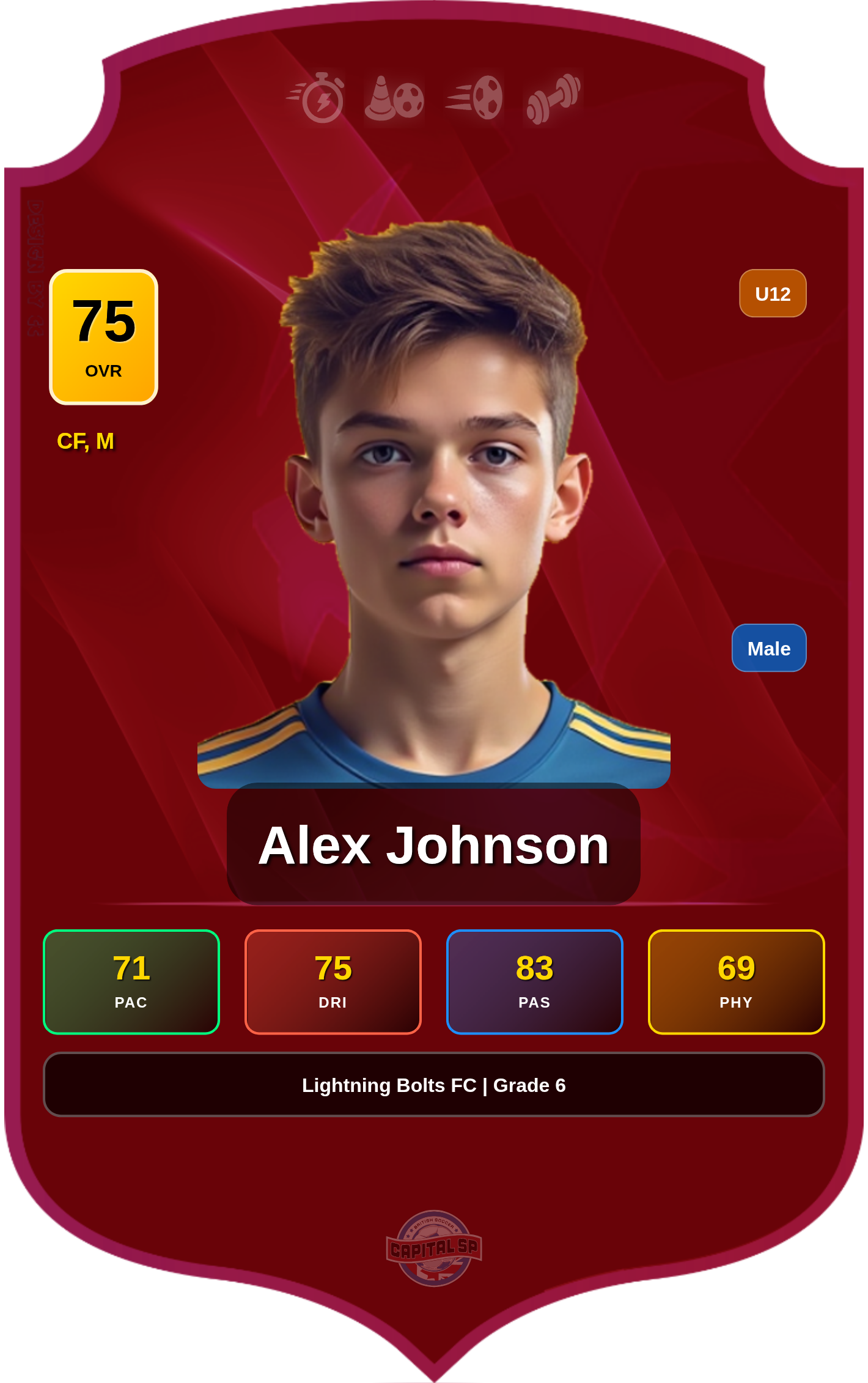
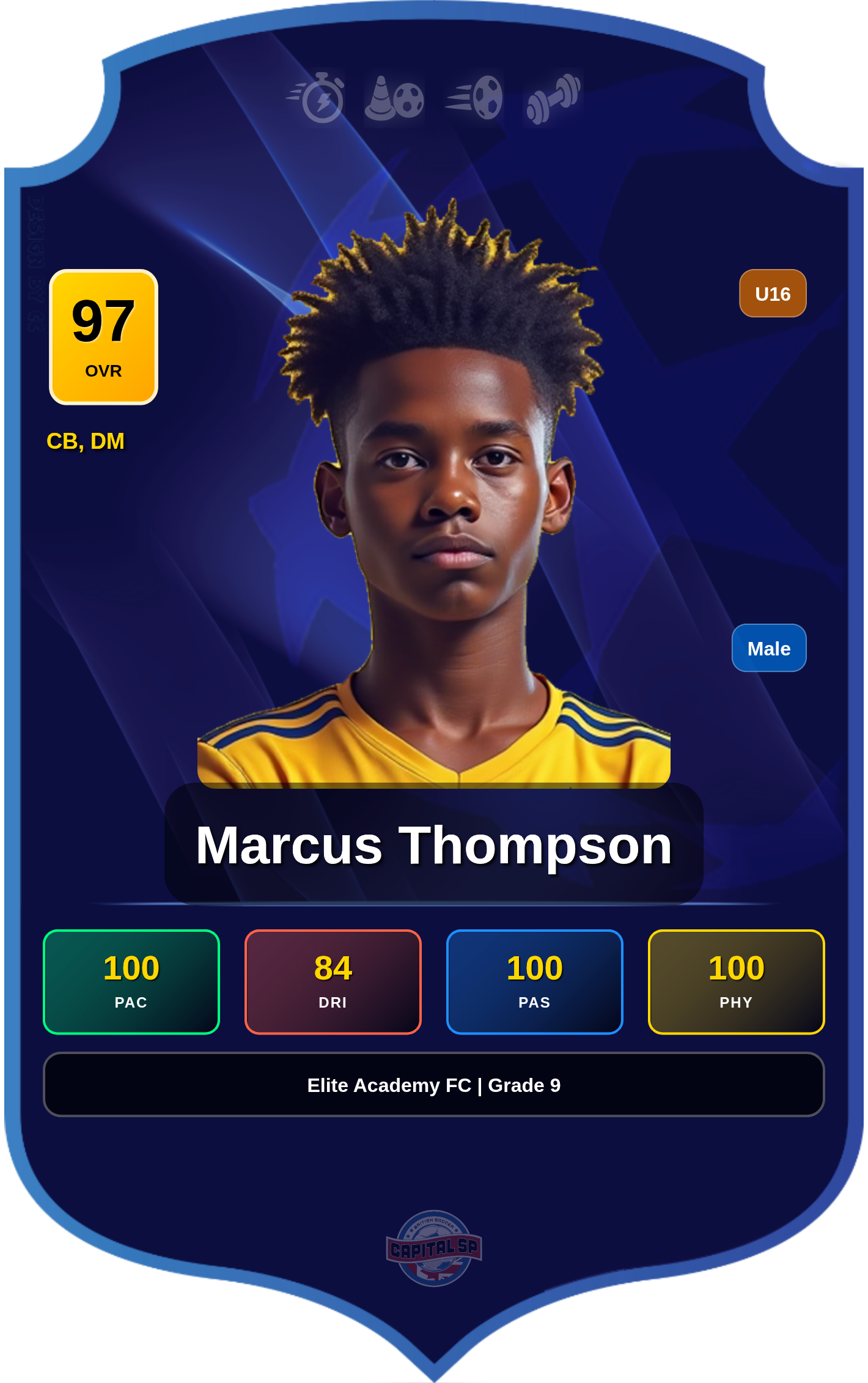
Your Player Proficiency Card displays four core attribute scores, each representing a distinct area of soccer capability. These scores are derived from the proficiency tests and are presented on a 0 to 100 scale. Here's what each one means — and what it looks like on the pitch.

PAC — Pace
Speed, acceleration, change of direction, and dynamic movement. A player with a high PAC score has the physical tools to exploit space behind defenders, press opponents effectively, and win foot races in one-on-one situations.

DRI — Dribbling
Ball control under pressure, carrying the ball with confidence, and maintaining composure while moving at speed. A player with a high DRI score can beat opponents in one-on-one situations and keep possession in congested areas.

PAS — Passing
Accurate delivery and reliable receiving ability — the fundamental connection point of team play. A player with a high PAS score can find teammates consistently, receive cleanly, and execute the building blocks of possession football.

PHY — Physical
Endurance, coordination, balance, agility, and the ability to sustain effort over a full match. A player with a high PHY score maintains their technical quality when fatigued — when most errors in youth soccer occur.
The Overall Rating (OVR)
A single number (0–100) that combines all four core attributes into one at-a-glance indicator of a player's assessed proficiency level, using a weighted formula that reflects the relative importance of each attribute.
| OVR Range | General Indication |
|---|---|
| 75–100 | Exceptional proficiency — the player demonstrates very strong ability across assessed areas |
| 55–74 | Solid developing proficiency — good foundational ability with clear room for targeted improvement |
| 35–54 | Emerging proficiency — the player is building their skills and has identifiable areas for focused development |
| Below 35 | Early stage — the player is at the beginning of their development journey with significant growth potential |
Important: These ranges are general guides. A 12-year-old with an OVR of 50 is at a very different stage than a 16-year-old with the same score. Always consider age and development context when interpreting any score.
Age-Adjusted Development
One of the most important aspects of the proficiency system is that it accounts for the developmental stage of each participant. Younger players naturally have less physical development than older ones, so the system includes an age-adjustment factor that ensures fairness across age groups.
A 13-year-old achieving the same result as a 16-year-old receives a higher adjusted score — because achieving that at an earlier stage of physical development is genuinely more impressive and suggests greater potential.
This means participants are effectively compared within their developmental context. Progress over time is more meaningful — as a player develops, their scores reflect genuine improvement rather than simply getting older.
PAC — Pace
What it measures: A player's overall speed profile — how quickly they can accelerate, reach top speed, change direction, and move dynamically across short and longer distances.
High PAC on the pitch
A player with a high PAC score has demonstrated the ability to cover ground quickly, react to situations with speed, and change direction without losing momentum. These players have the physical tools to exploit space behind defenders, press opponents effectively, recover defensive positions, and win foot races in one-on-one situations.
Developing PAC
A player with a lower PAC score may benefit from targeted speed and agility development. This doesn't mean they can't be effective — many world-class players compensate with superior positioning, anticipation, and technical ability — but it highlights an area where physical development can directly improve their on-field impact.
Real-World Example
When a through ball is played into space, the player with higher pace is more likely to reach it first. When an opponent breaks through on a counter-attack, a defender with strong pace can recover and close the gap. These situations happen dozens of times in every match — pace is the foundation of physical competitiveness.
In a match, PAC determines:
- Can they get to a through ball before the defender?
- Can they recover when caught out of position?
- Can they press effectively, closing down space and time on the ball?
- Can they exploit transitions, turning defence into attack quickly?
DRI — Dribbling
What it measures: A player's ability to control the ball while moving, maintain possession under pressure, and handle the ball in tight or dynamic situations.
High DRI on the pitch
A player with a high DRI score has shown strong ball control, the ability to carry the ball with confidence, and the focus to maintain composure while moving at speed. On the field, this translates to a player who can receive the ball and advance with it, beat opponents in one-on-one situations, and keep possession in congested areas of the pitch.
Developing DRI
A player with a lower DRI score has an opportunity to develop their close ball handling and movement with the ball. Improving here directly affects a player's confidence on the ball and their willingness to take players on, receive under pressure, and contribute creatively.
Real-World Example
Picture a midfielder receiving the ball in the centre of the pitch with opponents closing in. A player with strong dribbling ability can take a touch, shift direction, and escape pressure to find a passing option. A player still developing this skill might rush their touch or lose the ball under the same pressure. Dribbling proficiency is what turns a tight situation into an attacking opportunity.
These are the players who can:
- Carry the ball forward under control at pace
- Beat opponents in tight situations
- Maintain composure and concentration while moving with the ball
- Turn a crowded midfield into an attacking opportunity
PAS — Passing
What it measures: A player's ability to deliver accurate passes consistently and to receive and control the ball effectively — the fundamental connection point of team play.
High PAS on the pitch
A player with a high PAS score has demonstrated reliable passing accuracy and good receiving ability. These players are the connectors — they can find teammates with short and medium-range passes, receive the ball cleanly under various conditions, and execute the basic building blocks of possession football.
Developing PAS
A player with a lower PAS score may find that their intended passes don't always reach their target, or that their first touch doesn't set them up well for the next action. Focused passing practice is one of the most impactful development investments a young player can make, as every position on the field demands passing competency.
Real-World Example
A centre-back who can play an accurate 20-yard pass to a midfielder's feet has more options than one who can't. A winger who can receive and control a switch of play without taking extra touches can attack the space before the defence recovers. Passing proficiency is the difference between a team that circulates the ball and creates chances and one that gives possession away repeatedly.
Strong PAS means:
- Delivering the ball accurately to a teammate's feet or into the appropriate space
- Receiving and controlling the ball in a way that sets up the next action
- Reacting quickly and making good decisions under time pressure
PHY — Physical
What it measures: A player's overall physical profile — endurance, stamina, coordination, balance, agility, basic motor skills, and the ability to sustain effort over the duration of a match.
High PHY on the pitch
A player with a high PHY score has shown they can sustain effort, maintain coordination and balance, and demonstrate the physical foundation needed for competitive play. This manifests as a player who can compete for the full duration of a match, win physical challenges, maintain their technical quality when fatigued, and demonstrate good aerial ability.
Developing PHY
A player with a lower PHY score may find they fade in the latter stages of matches, struggle to compete physically against peers, or find their technical execution drops when they're tired. Physical development is cumulative — consistent work here pays dividends across every other attribute.
Real-World Example
A player who can jump the highest — both in absolute terms and relative to their own height — demonstrates explosive power and coordination that translates directly into winning aerial duels, whether from corners, goal kicks, or crosses into the box. A player who scores well across all physical components shows the broad athletic foundation that supports everything else they do on the pitch.
Strong PHY means:
- Competing for a full match without significant performance drop-off
- Winning physical contests — in the air, in shoulder-to-shoulder challenges, in sustained pressing duels
- Maintaining technical quality when fatigued
- Demonstrating the coordination and agility needed to execute skills in dynamic, unpredictable match situations
Common Questions
We recommend participating in every scheduled testing session. Results have a validity window, and regular testing ensures your child's PPC always reflects their current ability. Missing sessions means their card will be based on older or incomplete data — which can significantly understate their true level.
The Standard We Hold Ourselves To
Real Accountability. Real Results.

Join the movement for real accountability in youth soccer — where every player's development is measured, not guessed.
Capital-SP Academy — Proficiency Testing

Ask us how your child's Player Proficiency Card can become the roadmap for their development journey.
Get in touch — we'd love to hear from you